Last checked: 7 November 2026. The Google guidance quoted below was read on that date, and each link goes to the original page so you can check it yourself.
Disclosure: Linkvista sells guest posts and niche edits to UK agencies and businesses, and our link quality policy rules out private blog networks completely. We have a commercial interest in the topic, so this guide sticks to checks you can run yourself and links to Google’s own documentation wherever we describe how Google treats links.
Private blog networks, or PBNs, are still sold to agencies as “high-DR guest posts”, “authority links” or “homepage links on aged domains”. The marketing rarely says “PBN”. That is why knowing how to spot a PBN matters more than knowing the definition: if you resell links to clients, the risk sits with your client’s site and with your agency’s reputation, not with the vendor.
This guide explains what a PBN is, why it is a poor bet for client work, the warning signs you can check in a few minutes, and the vetting process we use so that none of these sites reach an agency shortlist.
What is a PBN (private blog network)?
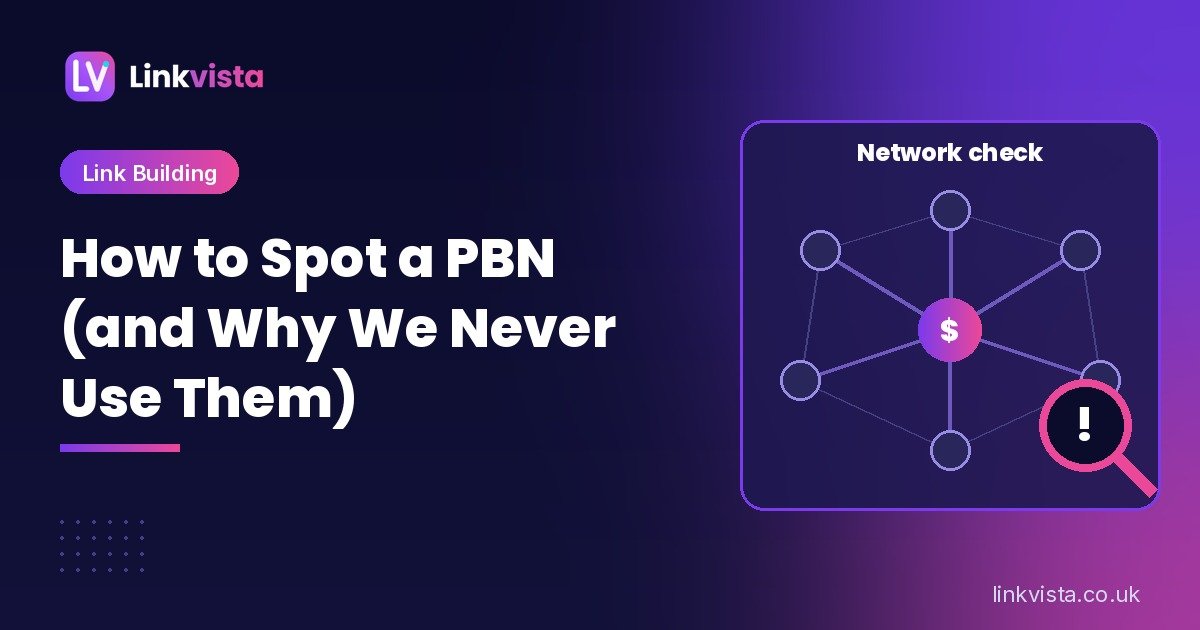
A private blog network is a group of websites controlled by one person or operator and built mainly to pass links to other sites. The sites are made to look independent, often with different themes, author names and hosting, but they exist to sell or point links rather than to serve readers.
Many PBNs are built on expired domains. The operator buys a domain that already has backlinks from its previous life, puts up a basic blog, and sells links from it on the strength of that inherited authority score. The content is usually thin, broad and written to carry outbound links.
Google does not use the term “PBN” in its documentation, but the practices behind one are named directly in its spam policies for Google web search:
- Link spam: “creating links to or from a site primarily for the purpose of manipulating search rankings”, including “creating low-value content primarily for the purposes of manipulating linking and ranking signals”.
- Expired domain abuse: buying an expired domain and repurposing it “primarily to manipulate search rankings by hosting content that provides little to no value to users”.
- Policy circumvention: creating new sites, subdomains or subdirectories “with the intention of continuing to violate our policies”.
Why PBN links are a bad bet for agency clients
The case against PBNs is not only ethical. It is practical, and it is documented.
Google says it can detect sites built to pass links
In its December 2022 link spam update announcement, Google said its AI-based system, SpamBrain, “can now detect both sites buying links, and sites used for the purpose of passing outgoing links”. It added that ranking may change “as spammy links are neutralized and any credit passed by these unnatural links are lost”. A network whose only job is passing outgoing links is exactly the kind of site that statement describes.
Expired domain abuse has its own policy
When Google introduced its expired domain abuse policy in March 2024, it wrote that this “isn’t something people accidentally do”, and that such domains “are generally not intended for visitors to find them in any other way but through search engines”. It also confirmed that using an old domain for “a new, original site that’s designed to serve people first” is fine. The difference is purpose, which is why the checks below focus on whether a site has real readers and a coherent history.
Manual actions are slow and expensive to fix
Google’s Manual actions report help page lists “unnatural links to your site” as one action it can apply. The fix is to remove the links, or ask the linking sites to qualify them, then disavow what you could not remove, and submit a reconsideration request. Google notes that “link-related reconsideration requests” may take longer than usual to review. For an agency that is unbilled clean-up time and an awkward client conversation.
The links disappear when the network does
PBN operators drop domains, change hosting or let sites lapse when they stop paying. When a network is de-indexed or abandoned, every link on it goes with it, and the client’s report suddenly has holes in it.
One honest caveat: Google’s link spam policy also covers paid links in general. It lists “exchanging money for links, or posts that contain links” and paid guest posts with links that pass ranking credit, and says paid links are fine when qualified with rel="sponsored" or rel="nofollow" (see Google’s guide to qualifying outbound links). No vendor can promise that any paid placement is risk-free. What you can control is whether a link sits on a real, relevant site with an editorial audience, or on a network that exists only to pass links. The second is the one Google describes detecting.
How to spot a PBN: 12 warning signs
No single sign proves a site is part of a network. Two or three together should stop the purchase until the vendor can explain them.
Content and editorial signs
- The site covers everything. Health one day, crypto the next, then home improvement and travel. Real blogs have a topic; link-selling sites have a price list.
- Almost every post has an outbound commercial link. Open five or six recent articles. If each one links out to a different business with a keyword-rich anchor, the site is selling links, not publishing for readers.
- Thin, generic articles. Short posts with no original detail, no images of their own and no clear reason to exist other than the link in the second paragraph.
- No real author or owner. Author names with no bio, no social profile and no other bylines anywhere; an “About” page that says nothing; a contact page with only a form.
- No engagement anywhere. No comments, no newsletter, no social accounts that anyone follows, and no sign of readers beyond search engines.
Domain history signs
- A history that does not match the current site. Look the domain up in the Internet Archive’s Wayback Machine. A former bakery, charity or school that is now a general “business and lifestyle” blog is a classic expired-domain rebuild.
- Old domain, new site. A domain registered many years ago but with content that starts recently, often after a gap. Check the registration date with our free domain age checker or ICANN Lookup, then compare it with the oldest posts on the site.
- Backlinks that point to pages that no longer exist. If the site’s strongest backlinks were earned by the previous owner’s content, the authority score describes a site that is gone.
Traffic and metric signs
- High authority score, almost no organic traffic. A DR 50+ site with a few hundred estimated visits is the most common PBN profile. We cover this mismatch in detail in DR vs traffic: how to judge backlink quality.
- Traffic from the wrong keywords or the wrong country. A UK “marketing” blog whose traffic comes from unrelated foreign-language terms is usually a rebuilt domain still living off old rankings.
Network footprint signs
- Identical layouts and patterns across a vendor’s list. Same theme, same footer, same “write for us” wording, same post length and same anchor style on several domains from one vendor. Networks reuse templates because building them is a cost.
- The sites link to each other. Run a few domains from a shortlist through a backlink tool or our link analyzer. If they keep pointing to the same handful of money sites, or to each other, you are probably looking at one operator’s network.
Hosting overlaps (many domains on the same server or IP range) are sometimes mentioned as a sign too. They can be useful, but shared hosting means plenty of unrelated legitimate sites sit on the same IPs, so treat it as supporting evidence rather than proof.
A 10-minute PBN check before you approve a domain
You do not need a paid tool stack to rule out most networks. For each domain on a shortlist:
- Read the homepage and three recent posts. Is there a clear topic, and would someone in your client’s industry actually read this?
- Count outbound commercial links in those posts and note the anchors. Exact-match money anchors in every post is a red flag.
- Check the archive history in the Wayback Machine for the last few years. Look for a change of owner or topic.
- Compare domain age with content age. Use the domain age checker, then scroll to the oldest post.
- Compare authority with organic traffic and look at the trend, not one month. A sharp drop can indicate a penalty or a de-indexed section.
- Search Google for the site’s own name. A real publication usually shows up with social profiles, mentions or other footprints. A PBN often shows only itself.
- Ask the vendor directly: “Do you own or control any of these sites?” and “Can you show the editor’s contact?” A straight answer is a good sign; a vague one is not.
For a broader checklist that also covers relevance, indexation and outbound link density, see our guide on how to vet a guest post site before buying.
What to do if a client already has PBN links
New clients sometimes arrive with links from a previous provider. Google’s guidance on disavowing links says that in most cases Google can assess which links to trust without extra help, and that disavowing is an advanced feature that can harm performance if used incorrectly. It recommends disavowing only if a site has “a considerable number of spammy, artificial, or low-quality links” and they have caused, or are likely to cause, a manual action.
A sensible order of work for an agency is:
- Check the client’s Manual actions report in Search Console first.
- Export links from Search Console’s Links report and list the domains that match the warning signs above.
- Where there is a manual action, try to get links removed before disavowing, and keep a record of the requests, because Google asks for documentation in a reconsideration request.
- Stop any ongoing PBN purchases and replace them with editorial placements on relevant sites.
- Explain the change to the client in plain terms: fewer, real links rather than many links that may be discounted.
Why Linkvista never uses PBNs
Linkvista provides UK link building services to agencies who resell our work under their own brand. If a placement turns out to be part of a network, the agency carries the client conversation. So our link quality policy is strict:
- We do not own, rent or buy from networks of sites built only to pass links.
- We reject expired-domain rebuilds that rank for unrelated or foreign-language terms, and we check registration and archive history for every domain.
- Every site needs at least 500 monthly organic visits (third-party estimate), stable or growing over six months, from genuine keywords in its own niche.
- We check outbound link ratios and reject pages stuffed with sponsored links, hacked or hidden links, and gambling, adult, essay-mill or crypto-spam neighbourhoods.
- You approve every domain before anything goes live, so you can run the checks in this article yourself.
Once domains are approved, links go live within 48–72 hours. Guest posts include a standard 1,000-word article by a native-level writer, or you can supply your own article of 500 to 4,000 words; longer articles are charged extra per additional 500 words. If a link is removed within 12 months of going live, we replace it free. There is no replacement guarantee after 12 months.
If you are comparing providers more broadly, our guide to choosing a link building service in the UK lists the questions to ask any vendor.
Prices are in USD and depend on both Domain Rating and minimum organic traffic. Guest posts run from $99 (DR 20–29, 500+ visits a month) to $489 (DR 70+, 10,000+ visits a month), and niche edits from $85 to $389. Agencies get 10% off at 10+ links a month and 15% off at 25+. The full table is on our pricing page.
Frequently asked questions
What does PBN stand for in SEO?
PBN stands for private blog network: a group of websites controlled by one operator and built mainly to pass links to other sites, usually made to look like unrelated, independent blogs.
Are PBN links against Google’s rules?
Google’s spam policies do not use the word PBN, but they define link spam as creating links primarily to manipulate search rankings, including low-value content made for that purpose, and they have a separate policy on expired domain abuse. A network built to pass links fits those descriptions.
Can a high-DR site still be a PBN?
Yes. Many PBNs are built on expired domains that kept their backlinks, so they show a high third-party authority score with little real organic traffic. Always compare DR with traffic, traffic trend and the site’s history.
How can I check a domain’s history?
Look the domain up in the Internet Archive’s Wayback Machine to see past versions, and check its registration date with a domain age tool or ICANN Lookup. A long registration history with only recent content, or a complete change of topic, points to a rebuilt expired domain.
Should I disavow PBN links pointing to my client’s site?
Not automatically. Google says most sites do not need the disavow tool, and recommends it only when there are many spammy or artificial links that have caused, or are likely to cause, a manual action. Check the Manual actions report first and try to get links removed before disavowing.
How do I know Linkvista’s sites are not PBNs?
You see and approve every domain before anything goes live, so you can run your own checks. Every site must meet our link quality policy, including at least 500 monthly organic visits, relevant traffic, clean outbound links and a coherent domain history, and we do not own or rent link networks.
How fast are links delivered, and what if one is removed?
Links go live within 48–72 hours of domain approval. If a link is removed within 12 months of going live, we replace it free of charge. Links are not guaranteed after 12 months.
Get PBN-free links for your clients
If you want links you can show to a client without worrying about who owns the site, send us your client’s niche and target pages. We will come back with a shortlist of real, relevant domains for your approval. See our link building services, check the USD pricing, try our free SEO tools, or contact us for a free sample domain list. Agencies reselling links can also read about our white label link building service.
Leave a Reply