
Last checked: 6 November 2026. The Google guidance quoted below was read on that date, and the links go to the original pages so you can check them yourself.
Disclosure: Linkvista sells guest posts and niche edits to UK agencies and businesses, so we have a commercial interest in how backlink quality is judged. This guide explains the checks we apply on every shortlist, including the Domain Rating and organic-traffic floors on our pricing page, so you can hold every provider to the same standard.
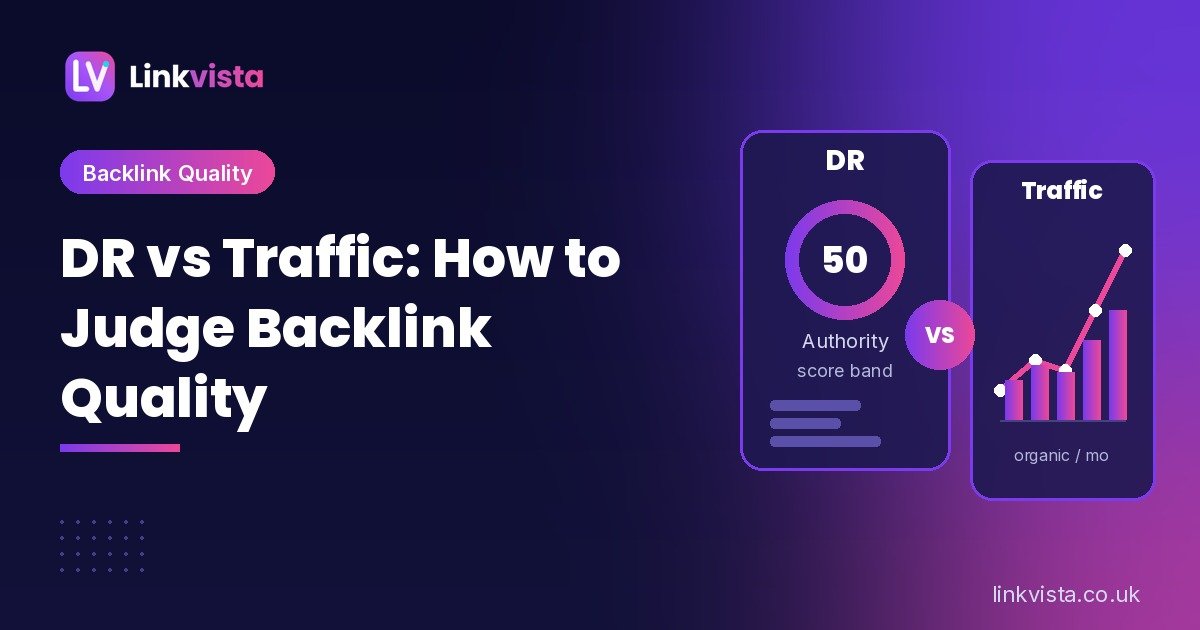
When agencies buy links, two numbers dominate the conversation: Domain Rating (or a similar third-party authority score) and estimated organic traffic. One without the other is a poor way to judge backlink quality. A high-DR site with almost no readers can look impressive on a spreadsheet and still be a weak placement. A busy site in the wrong niche can bring traffic that never helps your client.
This article is for UK SEO agencies buying guest posts and niche edits. It explains what those two metrics actually measure, why teams over-index on each of them, a practical checklist for vetting a site before you pay, and how Linkvista prices with both DR tiers and minimum organic traffic rather than a single score.
What Domain Rating measures (and what it does not)
Domain Rating, Domain Authority and similar scores are estimates published by SEO tools. They try to summarise how strong a site’s backlink profile looks relative to other sites in that tool’s index. Useful shorthand — and nothing more.
Google does not publish a public “Domain Rating”, “Domain Authority” or any official numeric authority score that you can look up for a site. Ranking systems are more complex than a single public number, and third-party tools estimate authority and traffic from their own crawls and models. Treat DR as a relative signal inside one tool, not as Google’s verdict on a domain.
What a high DR usually reflects is a larger or stronger referring-domain profile in that tool’s data. What it does not guarantee is:
- Real people reading the site today
- Topical relevance to your client
- A clean outbound-link neighbourhood
- Stable indexation or a healthy traffic trend
That is why buying “DR 50+ links” as a blank label is a weak brief. The score can be fine while the placement is still a poor fit.
What organic traffic measures
Organic traffic estimates (again from tools such as Ahrefs or Semrush) try to answer a different question: roughly how many visits the site appears to earn from search. For guest-post and niche-edit buying, that matters because a link on a page that nobody finds is less likely to be crawled in a useful context, less likely to be seen by real readers, and often a clue that the site is thin, abandoned or built mainly to sell links.
Traffic is also only an estimate. Different tools disagree, and Google’s own Search Console data for a site you do not own is not available to you. Use traffic as a filter and a trend check, not as a precise visitor count.
Google’s guidance on helpful content is a useful reminder of what traffic should represent. Its ranking systems are designed to prioritise “helpful, reliable information that’s created to benefit people, and not content that’s created to manipulate search engine rankings,” as set out in Google’s creating helpful, people-first content documentation. A site that still earns steady informational traffic in its own niche is more likely to meet that bar than a site that only looks strong on a backlink graph.
Why agencies over-index on DR alone
DR is easy to put in a proposal. Clients recognise the number. Vendors sort inventories by it. Reporting a “DR 55 guest post” feels concrete. The problems start when DR becomes the only acceptance test.
Common failure modes when DR is treated as quality:
- High DR, hollow traffic. The referring-domain graph looks strong, but estimated organic visits are tiny or collapsing. That pattern often means the site no longer earns attention, or that much of its “authority” is circular.
- Wrong niche, right score. A finance client does not need a DR 60 lifestyle blog that accepts every topic. Relevance beats a prettier metric.
- Link-seller pages. Some sites keep a decent DR while stuffing articles with outbound sponsored links. The score survives longer than the editorial standards.
- Stale inventory. Vendors re-sell the same high-DR domains for years without checking whether the pages are still indexed or whether traffic has fallen away.
Google’s spam policies for Google web search define link spam as “creating links to or from a site primarily for the purpose of manipulating search rankings,” and list buying or selling links for ranking purposes among the examples. Google also notes that buying and selling links “is a normal part of the economy of the web for advertising and sponsorship purposes” when those links are qualified with rel="nofollow" or rel="sponsored". Agencies still need editorial quality on the sites they use, because a paid placement on a spammy neighbourhood is a bad buy even when the paperwork is tidy.
The opposite mistake: traffic-only buying
Filtering only on traffic creates different problems. A large general site can show thousands of monthly visits while offering little topical overlap with your client. A news or deals site may have strong traffic and weak relevance. A site can also spike on branded or navigational queries that never put your article in front of the right readers.
Traffic without authority context can also hide risk. A young site with inflated short-term visits, or a site that recently recovered from a penalty, needs more than a single month’s estimate. Look at six-month trends, not a one-day screenshot.
The practical rule: use DR (or a similar score) as a coarse size/authority band, and organic traffic as evidence that real search demand still exists. Then decide on relevance, outbound density, indexation and neighbourhood. Metrics open the door; editorial judgement walks through it.
A practical checklist for guest-post and niche-edit sites
Before you approve a domain, run the same checks we document in our link quality policy and the longer walkthrough in how to vet a guest post site before buying. At minimum:
- Relevance first. The site and the target page should sit in a niche that makes sense for your client. A modest site in the right topic usually beats a high-DR site that accepts anything.
- Organic traffic with a floor and a trend. Require a minimum monthly estimate and check that traffic is stable or growing over roughly six months. Sudden collapses are a warning sign. Our own floor starts at 500+ monthly organic visits for Starter placements.
- Traffic source fit. Prefer sites whose visits come from genuine informational keywords in their own niche, not from unrelated or spammy queries.
- Outbound link density. Open recent articles. A sensible number of outbound links is fine; pages stuffed with sponsored links are not. Google’s link best practices say that “using external links can help establish trustworthiness (for example, citing your sources)” — the opposite of a page that exists mainly to sell anchors.
- Indexation. Confirm the site (and for niche edits, the specific page) appears in Google. A niche edit on a deindexed URL is wasted spend. Our free link analyzer and domain age checker can help with quick sanity checks alongside your usual SEO toolkit.
- Spam neighbourhoods. Skip PBNs, link farms, “write for us” mills that publish on every topic, expired-domain rebuilds, hacked or hidden links, and gambling, adult, essay-mill or crypto-spam environments. Linkvista never uses those.
- Editorial basics. Real authors or a clear about page, original content, a working contact route and a clean design are soft signals that still matter when you are choosing where a client’s brand appears.
If a vendor will not show domains before payment, you cannot run this checklist. Approval before publish should be non-negotiable for agency work.
How Linkvista combines DR tiers with minimum traffic
Our pricing is built so every tier has both a Domain Rating band and a minimum organic traffic requirement. Content writing and placement are included for guest posts; you approve every domain before it goes live; turnaround is 48–72 hours from approval; and removed links are replaced free within 12 months. We do not use PBNs.
Current list prices (USD, per link, last checked 6 November 2026):
| Tier | Domain Rating | Min. organic traffic | Guest post | Niche edit |
|---|---|---|---|---|
| Starter | DR 20–29 | 500+/mo | $99 | $85 |
| Standard | DR 30–49 | 1,000+/mo | $125 | $109 |
| Premium | DR 50–69 | 5,000+/mo | $319 | $249 |
| Authority | DR 70+ | 10,000+/mo | $489 | $389 |
A niche edit costs less than a guest post in the same tier because no new article is needed: your link is added to an existing, already indexed page. Guest posts include a standard 1,000-word article by a native-level writer; you can also supply your own article of any length, and longer pieces are charged extra per additional 500 words. Agencies ordering 10 or more links a month get 10% off list price; 25 or more get 15% off. NDA and unbranded reports are included for white-label work.
That dual threshold is deliberate. DR alone would let through quiet sites that still score well on referring domains. Traffic alone would let through busy but poorly matched publishers. Together with the manual checks above, the tiers keep shortlists closer to what agencies actually need for client campaigns. For service scope, see guest posting, niche edits and broader link building, or the full services overview.
Illustrative example: reading a shortlist with both metrics
Illustrative example (not a real client): suppose an agency needs six placements in month one for a UK B2B software client — a mix of relevance-led Standard sites and one stronger Premium guest post.
- Three Standard guest posts at $125 = $375
- Two Standard niche edits at $109 = $218
- One Premium guest post at $319 = $319
List-price total: $375 + $218 + $319 = $912. If the same mix sat inside a 10+ links/month retainer, the 10% agency discount would bring that illustrative month to $820.80 before any longer-article surcharges.
What the spreadsheet should also show, before anyone pays, is that every proposed domain clears its tier’s traffic floor, sits in a relevant niche, and passes the outbound and indexation checks. A “cheaper” DR 55 site with 200 estimated visits would fail our Premium bar (5,000+/mo) and should fail yours too. For how packages like this are scoped, see link building packages; for wider UK cost context, see how much link building costs in the UK; and for running the work as a campaign rather than a shopping list, see what a good SEO link building campaign looks like. If you are weighing niche edits specifically, what are niche edits? covers the format and the risks.
How to brief a vendor without getting metric theatre
When you ask for a shortlist, specify both bands and the editorial tests. A clear brief sounds like this:
- DR band (or equivalent) and minimum organic traffic
- Required topical fit and any niches to avoid
- Guest post vs niche edit mix
- Domain approval before publish
- Reporting fields: live URL, target page, anchor, date, DR and traffic snapshot used at vetting
- Replacement terms in writing
Refuse inventories that only list DR. Refuse “traffic” screenshots with no date range. Prefer vendors who will say no to a high-DR site that fails relevance or outbound checks. Our free SEO tools will not replace a full audit, but they are useful while you spot-check a shortlist.
Frequently asked questions
Is Domain Rating the same as Google’s ranking score?
No. Domain Rating and similar scores are third-party estimates. Google does not publish a public DR or DA number for websites. Use those scores as relative guides inside one tool, alongside traffic, relevance and editorial checks.
Why does Linkvista require both DR and traffic?
Because either metric alone is easy to game or misread. A DR floor sets a coarse authority band; a traffic floor filters for sites that still attract search visits. Manual vetting then checks relevance, outbound density, indexation and spam neighbourhoods.
What organic traffic minimum should I use?
It depends on budget and niche, but a hard floor beats “whatever the vendor has”. Linkvista’s published floors are 500+/mo (Starter), 1,000+/mo (Standard), 5,000+/mo (Premium) and 10,000+/mo (Authority), with a preference for stable or growing six-month trends.
Can a lower-DR site be better than a higher-DR site?
Yes, when relevance, traffic quality and outbound standards are stronger. A well-matched DR 35 site with steady niche traffic is often a better agency buy than a DR 60 generalist that sells links into every vertical.
Do niche edits need the same traffic checks as guest posts?
Yes — and you should also confirm the specific page is already indexed, because the link is added to existing content rather than a new article. See our niche edits service for scope and pricing by the same DR and traffic tiers.
How fast do Linkvista links go live, and what if one is removed?
Links go live within 48–72 hours of domain approval. If a link is removed within 12 months of going live, we replace it free. Links are not guaranteed after 12 months.
Where can I see current prices?
On our pricing page: guest posts from $99 to $489 and niche edits from $85 to $389 (USD), with 10% off at 10+ links a month and 15% off at 25+. Contact us if you want a domain shortlist against a client brief.
Judge backlink quality before you buy
Backlink quality is not a single score. Domain Rating (or any third-party authority metric) estimates link-graph strength; organic traffic estimates whether real search demand still exists; relevance, outbound standards, indexation and neighbourhood decide whether the placement belongs on a client site. Use both metrics, then apply editorial judgement.
If you want a shortlist built that way, view Linkvista pricing or contact us with the target pages, niche and monthly budget. We reply within 1 day with domains for your approval — never a blind DR list.
Leave a Reply